Mold on Floor Joists: Causes, Health Risks, and What to Do About It
Last updated: August 2026
Finding mold on the floor joists in your crawl space is more common than most homeowners realize, and in Rutherford County's climate, it's often less about a specific mistake and more about ordinary humidity doing what humidity does in an unsealed space. That doesn't make it something to ignore — but it also isn't necessarily the disaster it looks like at first glance.
Here's what it typically looks like, whether it's actually dangerous, and what dealing with it involves.
What does it look like?
Mold on floor joists usually shows up as one of two types.
Surface mold (white or gray) appears as a fuzzy or powdery coating, sometimes patchy, sometimes covering larger sections of a joist. This is the most common type found in vented crawl spaces and generally reflects ongoing humidity rather than a single water event.
Black mold appears as darker, sometimes slightly slimy-looking patches, and tends to show up in areas with more consistent moisture — near standing water, a slow leak, or a spot with poor air movement.
Both types can look alarming under a flashlight in a cramped crawl space. Visual identification alone doesn't tell you much about severity — a small patch of black mold isn't necessarily worse than a large area of white surface mold. What matters more is the underlying moisture source and how long it's been active.
Is it dangerous?
For the house, yes — left alone, mold weakens wood fiber over time and is usually a sign that moisture is doing damage beyond what's visible.
For people in the house, it depends. Mold exposure is most commonly a concern for anyone with asthma, allergies, or respiratory sensitivity, and less of a concern for people without those conditions. The relevant detail most homeowners don't realize: air doesn't stay contained in the crawl space. Roughly half of the air circulating through a typical home first passed through the crawl space, pulled up through the floor by pressure differences between the house and the space beneath it. That means mold spores and the musty compounds they produce don't stay under the floor — they travel into hallways, closets, and HVAC ductwork.
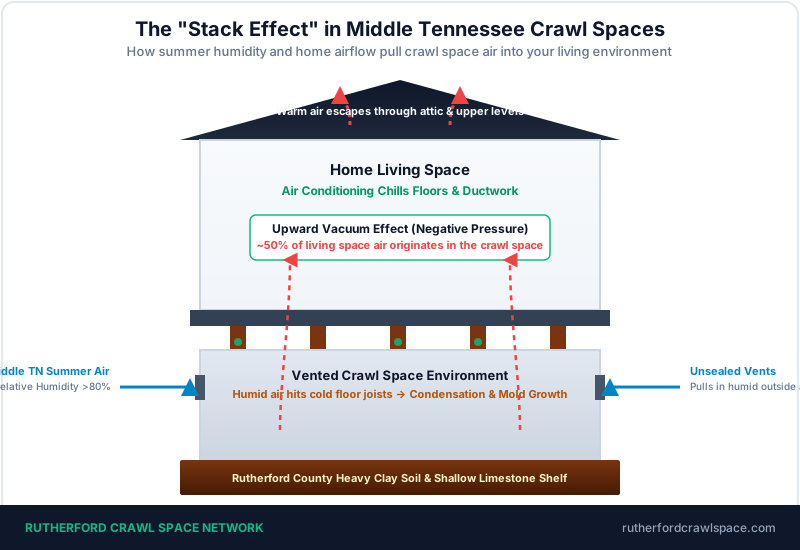
This is why the fix for crawl space mold isn't really about the mold itself. It's about the humidity that let it grow, because treating the visible mold without addressing that just means it comes back.
This page provides general information and is not medical advice. If you're experiencing symptoms you suspect may be related to mold exposure — respiratory irritation, allergy-like symptoms, or anything more severe — consult a doctor. For detailed health information, see the CDC's guidance on mold and health.
Why it happens in Rutherford County specifically
Rutherford County sits in a mixed-humid climate zone where summer relative humidity routinely exceeds 80% for weeks at a time. In a vented crawl space, that hot, moist outside air gets pulled in through the foundation vents and hits cooler surfaces — floor joists, sill plates, and ductwork chilled by indoor air conditioning.
When humid air meets a cold surface, it condenses. That condensation is a steady, repeating moisture source all summer long, and it's happening whether or not there's ever been standing water or a leak. Floor joists are especially prone because they're often the coldest accessible surface in the space, and mold only needs wood moisture in roughly the 20% range to start colonizing.
This is also why mold on floor joists is common even in crawl spaces that look otherwise dry — the moisture source is airborne condensation, not ground moisture, and it's easy to miss without a moisture reading.
Can I treat it myself?
For a small, isolated patch of surface mold on a single joist, some homeowners do attempt DIY treatment, and it's not unreasonable to try. The honest limitations, though:
- Spraying or wiping mold without containment can spread spores into the rest of the crawl space and, through the air pathways described above, into the house
- Surface treatment doesn't fix the humidity that caused the growth in the first place, so it commonly returns within a season
- It's genuinely difficult to tell from a flashlight inspection how far mold has spread along a joist versus just being visible in one spot
For anything beyond a small, contained patch, professional remediation — which includes both treating the existing mold and correcting the humidity source — is the difference between a fix and a temporary delay.
The EPA's guide to mold cleanup outlines when a job is small enough to handle yourself versus when professional remediation is the right call.
Frequently asked questions
Related guides: standing water in a crawl space, Rutherford County cost guide, and real estate inspection repairs.
Get a free inspection
A licensed local specialist can assess the extent of the mold, identify the moisture source, and give you a written scope of work — no pressure, no obligation.